
Introduction
If you’ve noticed white flakes on your shoulders and more hair in your brush than usual, you’re probably wondering: does dandruff cause hair fall? This concern is incredibly common, affecting millions of people worldwide who struggle with both dandruff and hair loss simultaneously.
The connection between dandruff and hair fall worries people because hair loss feels more permanent and distressing than flakes alone. When you’re dealing with an itchy, flaky scalp and simultaneously watching your hair thin, it’s natural to question whether these two problems are related—and more importantly, whether treating one will solve the other.
Here’s the short answer you’re looking for: Yes, dandruff can contribute to hair fall, but it’s usually temporary. Dandruff doesn’t directly cause hair to fall out, but the scalp conditions that accompany dandruff—inflammation, itching, and scratching—can weaken hair follicles and lead to increased shedding. The good news? Once you treat the dandruff and restore scalp health, hair fall typically decreases, and normal hair growth resumes.
This article explains exactly how dandruff and hair loss connect, why it happens, whether the damage is permanent, and most importantly, what you can do to stop hair fall caused by dandruff. You’ll get clear, science-backed answers without medical jargon, helping you understand your scalp health and take effective action.
What Is Dandruff?
Dandruff is a common scalp condition characterized by white or yellowish flakes of dead skin that shed from your scalp. These flakes often appear on your hair, shoulders, and clothing, accompanied by itching and sometimes scalp irritation.
Dandruff occurs when your scalp sheds skin cells faster than normal. While everyone’s scalp naturally sheds dead skin cells as part of the skin renewal process, people with dandruff experience accelerated shedding that becomes visible and problematic.
Why dandruff occurs: Several factors contribute to dandruff development:
- Malassezia yeast: A naturally occurring fungus that lives on everyone’s scalp but overgrows in some people, feeding on scalp oils and triggering irritation and increased cell turnover
- Seborrheic dermatitis: A condition causing oily, red, irritated skin covered with white or yellow scales
- Dry skin: Simply having a dry scalp can cause small, non-oily flakes
- Not shampooing enough: Oil and dead skin cell buildup can lead to dandruff
- Sensitivity to hair products: Contact dermatitis from certain ingredients can cause flaking
- Other skin conditions: Psoriasis and eczema can affect the scalp and cause dandruff-like symptoms
Difference between dandruff and dry scalp: Many people confuse these two conditions because both cause flaking, but they’re distinct:
- Dandruff flakes are larger, oilier, and often yellowish. They’re usually accompanied by an itchy, oily scalp, redness, and sometimes inflammation.
- Dry scalp flakes are smaller, drier, and white. They occur on a dry scalp without the oiliness or significant inflammation associated with dandruff.
This distinction matters because treatment approaches differ. Dandruff requires anti-fungal or medicated shampoos, while dry scalp responds to moisturizing treatments. Understanding what you’re dealing with is the first step toward effective treatment and preventing associated hair fall.
Does Dandruff Cause Hair Fall?
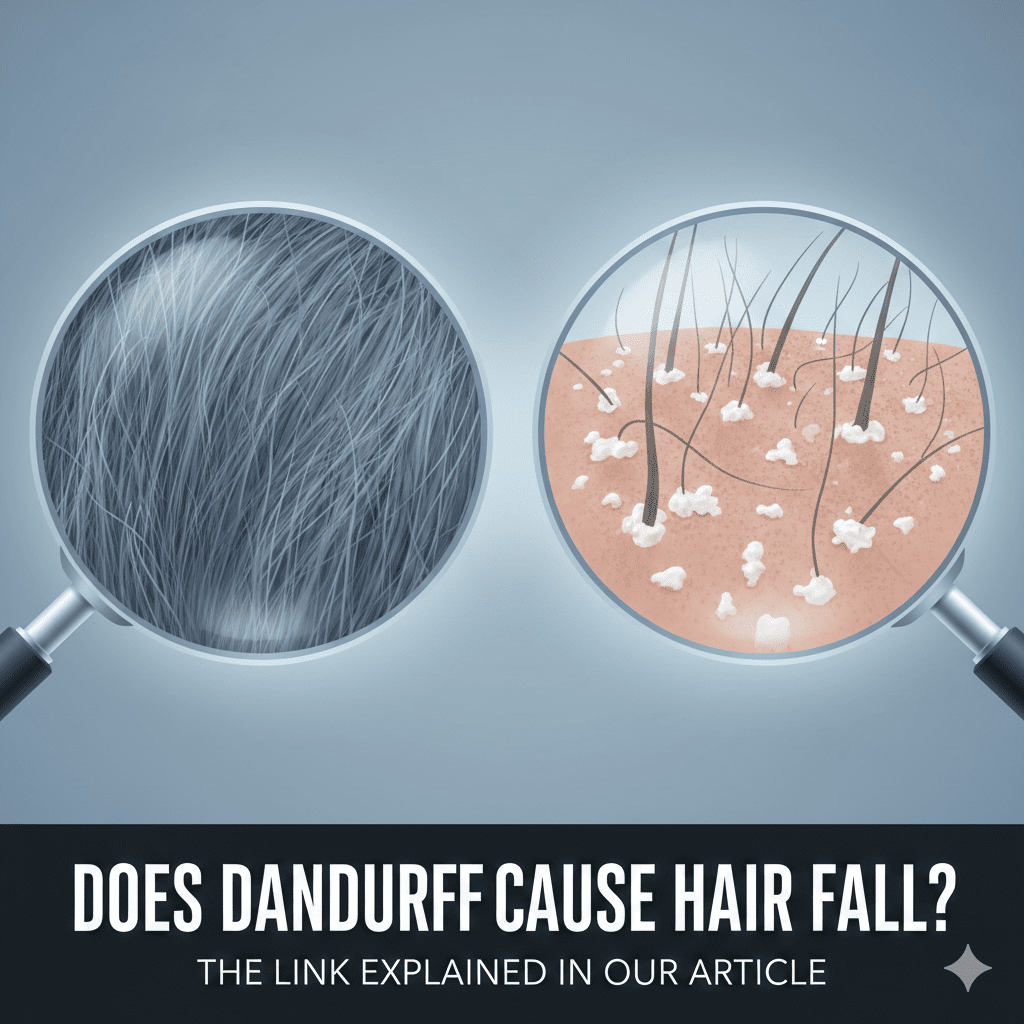
Yes, dandruff can increase hair fall, but it doesn’t directly cause hair to fall out. Instead, the conditions associated with dandruff—chronic inflammation, persistent itching, scratching, and poor scalp health—create an environment where hair follicles become weakened, leading to increased hair shedding.
To be clear: dandruff itself (the visible flakes) doesn’t make hair fall from your scalp. However, the underlying scalp issues that produce dandruff simultaneously affect hair follicles. When your scalp is inflamed, irritated, and constantly scratched, hair roots become damaged and weakened. This weakening causes hair to shed more easily than it normally would.
The important distinction: This is temporary, reactive hair loss (called telogen effluvium), not permanent pattern baldness. When dandruff is treated and scalp health improves, hair fall typically reduces, and normal hair growth cycles resume. Your hair follicles aren’t permanently damaged by dandruff—they’re temporarily stressed.
Think of it this way: dandruff creates hostile conditions on your scalp. Just as plants struggle to grow in poor soil, your hair struggles to remain firmly rooted in an unhealthy scalp environment. Fix the environment, and the hair growth improves.
Key takeaway: If you’re experiencing both dandruff and hair fall, treating the dandruff should be your priority. Addressing the root cause—your scalp health—will naturally reduce the associated hair loss.
Why Dandruff Can Increase Hair Fall
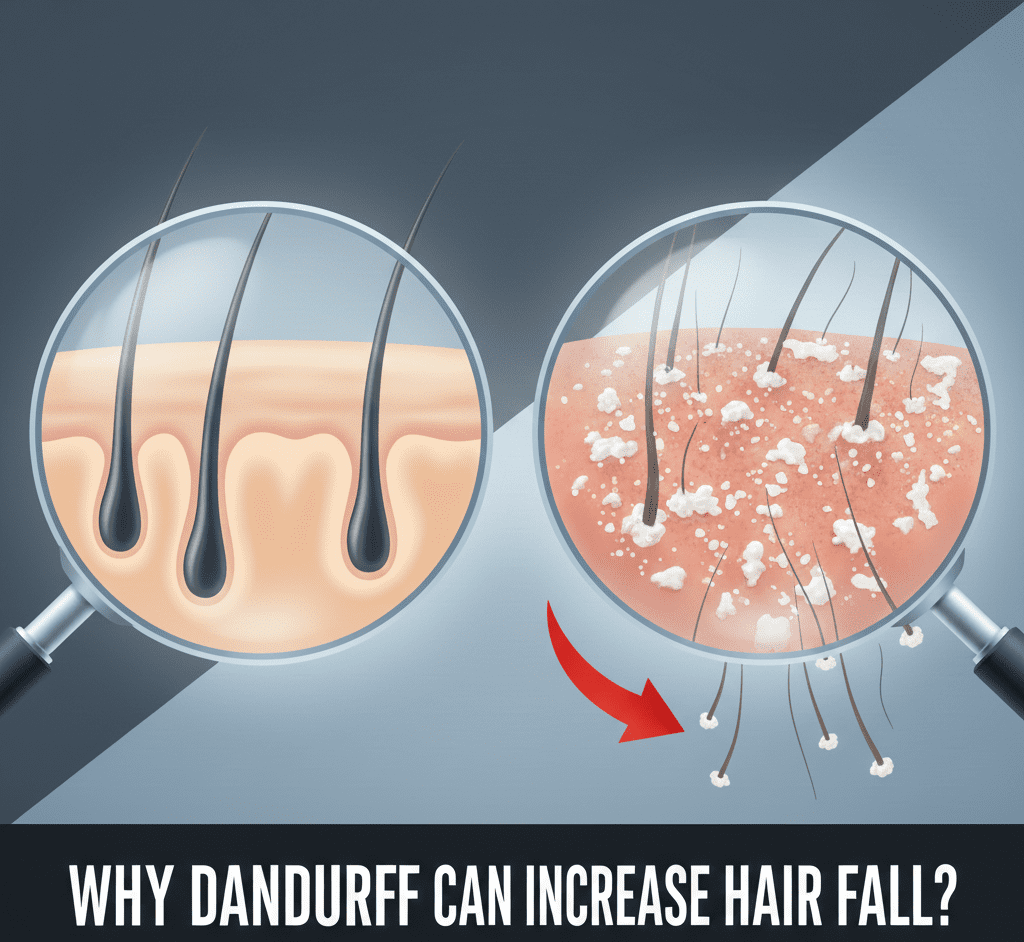
Understanding the mechanisms connecting dandruff to hair fall helps you address the problem effectively. Here’s how dandruff contributes to increased hair shedding:
Itchy Scalp and Scratching
The intense itching that accompanies dandruff is perhaps the most direct cause of hair fall. When your scalp itches persistently, scratching becomes almost involuntary—and this scratching causes significant damage.
How scratching damages hair: Your fingernails physically pull on hair shafts, weakening their attachment to follicles. Aggressive scratching can literally pull out hairs that were already in a weakened state. Even gentle scratching, when done constantly throughout the day, creates cumulative damage. You might not notice you’re doing it, but chronic scratching traumatizes both your scalp surface and hair roots.
Additionally, scratching breaks the scalp’s protective barrier, potentially introducing bacteria and causing further inflammation. This creates a vicious cycle: dandruff causes itching, itching leads to scratching, scratching worsens inflammation, and inflammation increases both dandruff and hair fall.
Many people experiencing hair fall due to dandruff don’t realize that their own scratching behavior is a major contributor. The solution isn’t just willpower—it’s treating the dandruff so the itching stops, eliminating the urge to scratch.
Scalp Inflammation
Dandruff is fundamentally an inflammatory scalp condition. The Malassezia yeast that contributes to dandruff triggers an immune response, causing inflammation, redness, and irritation even when not visibly apparent.
Chronic inflammation weakens hair follicles. When your scalp is constantly inflamed, several things happen:
- Blood flow to hair follicles may be reduced, limiting the nutrients and oxygen that reach hair roots
- Inflammatory compounds in the scalp tissue create a hostile environment for healthy hair growth
- The hair growth cycle becomes disrupted—more hairs enter the shedding phase prematurely
- Follicles become sensitive and reactive, producing thinner, weaker hair strands
This low-grade, persistent inflammation is why dandruff and hair loss often occur together. Even if you’re not actively scratching, the underlying inflammatory process affects hair follicle health and function.
Weak Hair Roots Due to Poor Scalp Health
Your scalp is the foundation for healthy hair growth, just as soil is the foundation for healthy plants. When dandruff compromises scalp health, hair roots cannot maintain their normal strength.
Poor scalp health manifests as: Imbalanced scalp pH, disrupted natural oil production, compromised skin barrier function, and accumulation of dead skin cells and product buildup. These conditions prevent hair follicles from functioning optimally.
Hair follicles in an unhealthy scalp environment produce weaker hair shafts that break more easily and shed prematurely. The hair growth phase (anagen) may shorten, while the resting phase (telogen) lengthens, resulting in less hair actively growing and more hair ready to shed.
This is why the question “does dandruff increase hair fall” has a clear yes—not through direct causation, but by creating conditions where hair cannot thrive.
Blocked Hair Follicles
Severe dandruff, especially when combined with excess sebum (oil) production, can lead to follicle blockage. Dead skin cells, oil, and product residue accumulate around hair follicles, essentially clogging them.
Blocked follicles cause multiple problems: The hair shaft may struggle to grow through the blockage, leading to thinner, weaker hair. Clogged follicles become breeding grounds for bacteria, potentially causing folliculitis (inflammation of hair follicles). Sebum and dead cell buildup can suffocate follicles, disrupting the normal hair growth cycle.
While this is more common in severe, untreated dandruff cases, it represents another mechanism through which dandruff contributes to hair loss. Keeping your scalp clean and treating dandruff effectively prevents this follicle blockage and the associated hair fall.
Is Hair Fall Due to Dandruff Permanent?
No, hair fall caused by dandruff is usually temporary and reversible. This is one of the most reassuring aspects of dandruff-related hair loss—once you address the underlying scalp condition, hair typically grows back normally.
Temporary versus permanent hair loss: The hair loss associated with dandruff is classified as temporary hair shedding (telogen effluvium), not permanent pattern baldness (androgenetic alopecia). The distinction is crucial:
- Temporary hair shedding: Hair follicles are stressed and push more hairs into the shedding phase prematurely, but the follicles themselves remain healthy and capable of producing new hair once conditions improve.
- Permanent hair loss: Hair follicles are genetically programmed to shrink and eventually stop producing hair altogether, as seen in male or female pattern baldness.
Dandruff affects the scalp environment, not the genetic programming of your follicles. When you treat dandruff, restore scalp health, and stop scratching, the stress on follicles is removed, and they return to normal functioning.
When hair usually grows back: Most people notice reduced hair fall within 2-4 weeks of effective dandruff treatment. However, seeing actual new hair growth takes longer because hair grows slowly—approximately half an inch per month. Visible regrowth typically becomes apparent within 2-3 months of successful dandruff treatment and improved scalp health.
Important caveat: If dandruff is left severe and untreated for extended periods (months to years), or if aggressive scratching has caused significant scarring, some permanent follicle damage could theoretically occur. However, this is rare. For the vast majority of people, treating dandruff promptly means hair fall is completely reversible.
If you’re also experiencing pattern baldness: Some people have both dandruff and genetic hair loss occurring simultaneously. In this case, treating dandruff will reduce the dandruff-related hair fall, but won’t address the genetic component. However, a healthy scalp gives you the best possible foundation for maintaining the hair you have.
The key message: Don’t panic. Hair fall from dandruff is almost always temporary. Focus on treating your dandruff, and your hair will likely recover.
Signs That Dandruff Is Causing Your Hair Fall
How do you know if dandruff is actually responsible for your increased hair shedding? Look for these telltale signs:
1. Visible flakes on scalp and shoulders: White or yellowish flakes are the hallmark of dandruff. If you notice these flakes coinciding with increased hair in your brush, on your pillow, or in the shower drain, there’s likely a connection.
2. Persistent itching: An itchy scalp that makes you scratch frequently, especially if the itching is worse in certain areas where you also notice more flaking and hair loss. The itching often intensifies when your scalp is oily or after going a day without washing.
3. Excessive hair shedding during washing and brushing: While everyone loses 50-100 hairs daily (this is normal), you might notice significantly more hair coming out when you shampoo or brush. If this increased shedding coincides with dandruff symptoms, they’re likely related.
4. Red or irritated scalp: Inflammation shows up as redness, sensitivity, or a burning sensation on your scalp. You might notice this when you part your hair or touch certain areas of your scalp. Inflamed areas often correlate with increased hair shedding.
5. Oily scalp with flakes: If you have an oily scalp that still produces flakes (rather than a dry, tight-feeling scalp), this suggests seborrheic dermatitis—a common dandruff cause that definitely impacts hair health.
6. Hair loss pattern: Dandruff-related hair fall is typically diffuse (spread across the entire scalp) rather than concentrated in specific areas like the hairline or crown. If you’re losing hair evenly across your head along with experiencing dandruff, they’re probably connected.
7. Timing correlation: If your hair fall increased around the same time your dandruff worsened, or if both improve and worsen together, this temporal relationship suggests causation.
When dandruff might NOT be the cause: If you have no visible flakes, no itching, no scalp irritation, but are still losing hair, dandruff probably isn’t your issue. Hair loss could stem from hormonal changes, nutritional deficiencies, stress, medications, or genetic factors instead.
Understanding these signs helps you determine whether treating dandruff should be your priority in addressing hair fall. If multiple signs apply to you, focusing on scalp health is your best first step.
How to Stop Hair Fall Caused by Dandruff
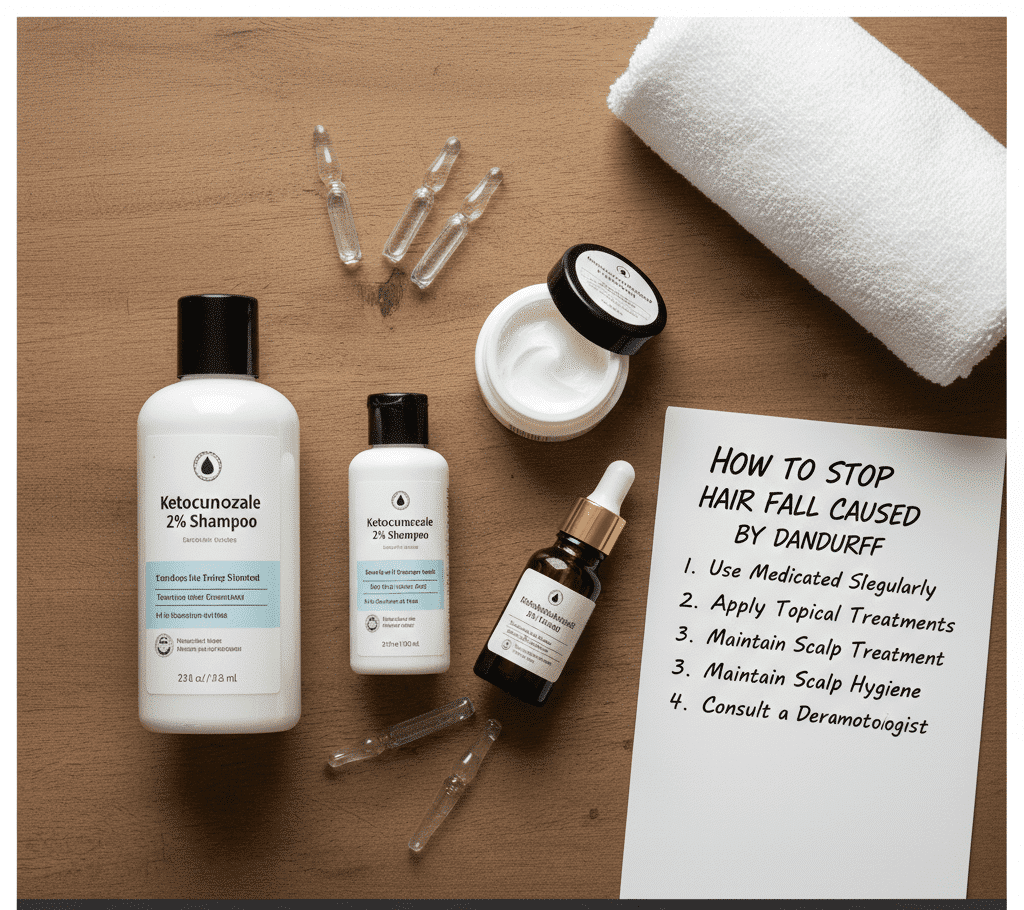
The solution to dandruff-related hair fall is straightforward: treat the dandruff and restore scalp health. Here’s how to do it effectively:
Treat Dandruff First
Your primary goal should be eliminating dandruff, not just reducing hair fall. When you successfully treat dandruff, hair fall naturally decreases as a secondary benefit. Don’t try to address hair loss separately while ignoring the underlying scalp condition.
Focus on: Reducing scalp inflammation, controlling Malassezia yeast overgrowth, normalizing the rate of skin cell turnover on your scalp, and restoring your scalp’s natural protective barrier.
Use the Right Shampoo
Anti-dandruff shampoos are your most effective tool for treating dandruff and preventing associated hair fall. Look for products containing these proven active ingredients:
- Zinc pyrithione: Anti-fungal and anti-bacterial properties that reduce Malassezia yeast
- Ketoconazole: Strong anti-fungal agent, particularly effective for stubborn dandruff
- Selenium sulfide: Reduces yeast and slows skin cell turnover
- Coal tar: Slows skin cell death and shedding (though it can be harsh)
- Salicylic acid: Helps remove scale buildup and exfoliates the scalp
How to use anti-dandruff shampoo effectively:
- Apply shampoo to wet hair and scalp
- Massage gently into scalp (don’t scratch with nails)
- Leave on for 5-10 minutes to let active ingredients work
- Rinse thoroughly
- Use 2-3 times per week initially, then reduce to once weekly for maintenance once dandruff improves
Many people make the mistake of using anti-dandruff shampoo like regular shampoo—applying and immediately rinsing. The contact time is crucial for effectiveness. Be patient; results typically appear within 2-4 weeks.
Avoid Scratching the Scalp
This is harder than it sounds when your scalp itches intensely, but it’s crucial. Scratching damages hair roots and worsens inflammation, creating a cycle that perpetuates both dandruff and hair fall.
Strategies to reduce scratching:
- Keep nails trimmed short to minimize damage if you do scratch
- When itching strikes, tap or press your scalp gently instead of scratching
- Apply anti-dandruff treatment immediately when itching begins rather than scratching
- Consider wearing a light head covering at night if you scratch in your sleep
- Use a scalp-soothing serum or oil to reduce itching sensation
As your dandruff treatment begins working, itching will decrease, making it easier to break the scratching habit.
Maintain Scalp Hygiene
Good scalp hygiene prevents dandruff from worsening and supports overall scalp health:
Best practices:
- Wash hair regularly based on your scalp type—2-3 times weekly for most people, more if very oily, less if very dry
- Rinse thoroughly to remove all shampoo and conditioner residue (buildup worsens dandruff)
- Don’t apply conditioner to your scalp—only to hair lengths and ends
- Avoid excessive use of styling products that can build up on scalp
- Clean your hairbrush regularly to prevent transferring oil, dead skin, and product back to your scalp
- Don’t share combs, brushes, or hats with others
Improve Diet for Hair Health
While diet won’t cure dandruff directly, proper nutrition supports scalp health and hair growth:
Focus on:
- Omega-3 fatty acids: Found in fish, flaxseeds, and walnuts—reduces inflammation
- Zinc: Supports immune function and wound healing—found in meat, legumes, nuts, and seeds
- B vitamins: Particularly biotin and B6—support scalp health and hair growth
- Protein: Hair is made of protein (keratin)—ensure adequate intake from lean meats, eggs, legumes, or dairy
- Vitamin D: Deficiency linked to various scalp conditions—get sunlight exposure or consider supplementation
- Antioxidants: Vitamins A, C, and E protect scalp from oxidative stress
Stay hydrated—water supports all bodily functions including skin and scalp health. While diet alone won’t solve severe dandruff, it provides the foundation for your scalp and hair to heal and thrive.
Home Remedies for Dandruff-Related Hair Fall
Many people prefer trying natural remedies before pharmaceutical treatments. Some home remedies can help with mild dandruff, though severe cases typically require medicated shampoos.
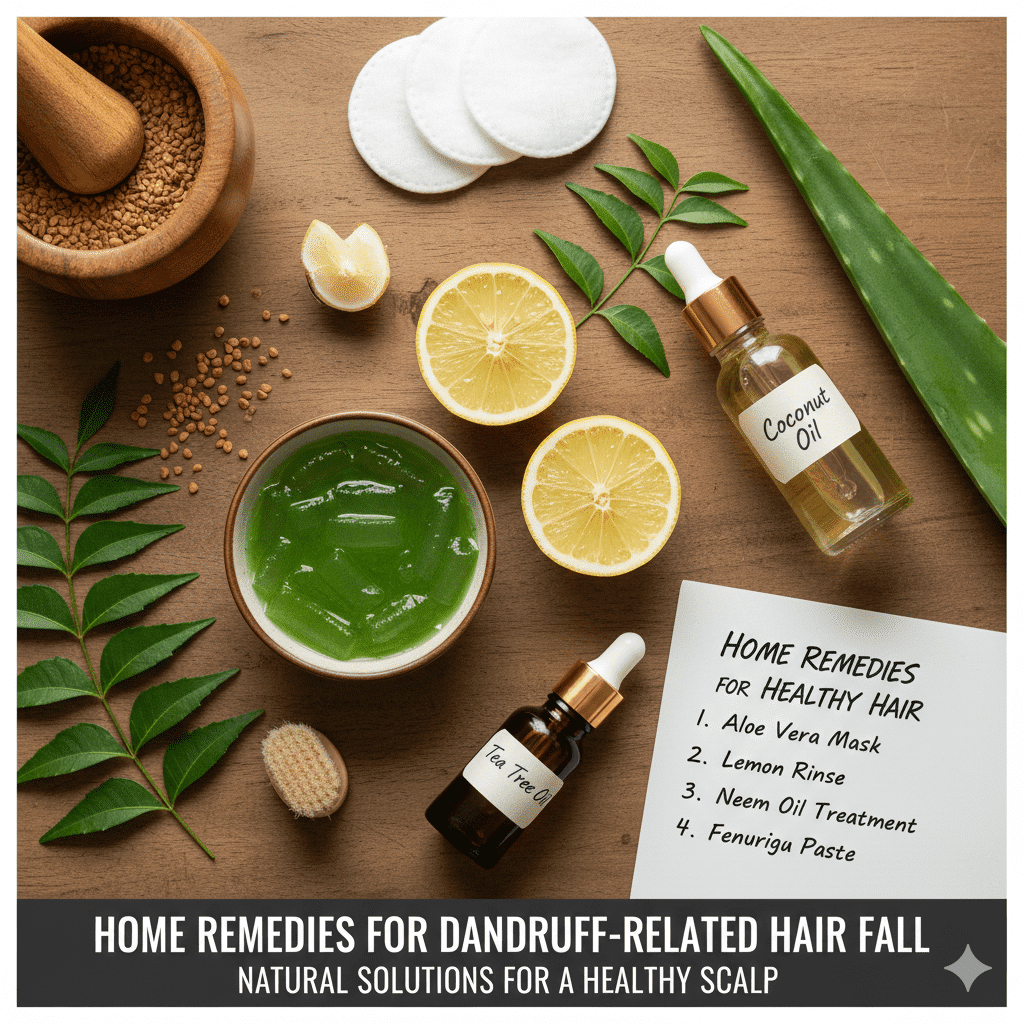
Popular natural remedies people search for:
Tea tree oil: Has anti-fungal properties that may reduce Malassezia yeast. Add a few drops to your regular shampoo or dilute with a carrier oil and massage into scalp before washing. Never apply undiluted.
Coconut oil: Moisturizes dry scalp and has some anti-fungal properties. Apply to scalp, leave for 30 minutes to overnight, then shampoo out. Works best for dry scalp rather than oily dandruff.
Aloe vera: Soothes inflammation and irritation. Apply fresh aloe vera gel to scalp, leave for 30 minutes, then rinse. Can reduce itching.
Apple cider vinegar: Balances scalp pH and has anti-fungal properties. Dilute 1 part vinegar with 1 part water, apply to scalp after shampooing, leave for a few minutes, then rinse. Don’t use on broken skin or open scratches.
Neem: Traditional anti-fungal and anti-bacterial herb. Boil neem leaves, cool the water, and use as a final rinse after shampooing.
Fenugreek seeds: Soak overnight, grind into paste, apply to scalp for 30 minutes, then wash. Some people find this reduces flaking.
Important safety note: Natural doesn’t automatically mean safe or effective. Some remedies can cause allergic reactions or irritation, especially on already sensitive scalps. Always patch test first by applying a small amount to your inner arm and waiting 24 hours. If you have severe dandruff or the condition worsens with home remedies, switch to proven medicated treatments.
Realistic expectations: Home remedies work best for mild dandruff and as complementary treatments alongside proven anti-dandruff shampoos. For moderate to severe dandruff causing significant hair fall, medicated treatments are typically more effective and faster-acting.
When Should You See a Doctor?
While most dandruff cases can be managed with over-the-counter treatments, certain situations require professional medical evaluation:
See a dermatologist if:
1. Severe dandruff that doesn’t improve: If you’ve used anti-dandruff shampoos consistently for 4-6 weeks without improvement, you need professional diagnosis and possibly prescription-strength treatments.
2. Excessive hair fall lasting more than a few weeks: If hair loss continues despite dandruff treatment, or if you’re losing more than 100-150 hairs daily for an extended period, underlying conditions beyond dandruff might be responsible.
3. Scalp pain, oozing, or signs of infection: Red, swollen, painful areas, pus, crusting, or spreading redness suggest infection (possibly from scratching) requiring medical treatment. Don’t attempt to self-treat infections.
4. Thick, crusty scales: If dandruff appears as thick, silvery, or crusty patches rather than loose flakes, you might have scalp psoriasis or severe seborrheic dermatitis requiring prescription treatments.
5. Hair loss in specific patterns or bald patches: If hair falls out in round patches, along a specific hairline pattern, or in concentrated areas, this suggests conditions like alopecia areata or androgenetic alopecia rather than dandruff-related shedding.
6. Dandruff spreading beyond scalp: If the flaking, redness, or irritation extends to your eyebrows, sides of nose, chest, or other areas, you likely have seborrheic dermatitis requiring medical management.
7. You have a compromised immune system: People with HIV/AIDS, undergoing chemotherapy, or taking immunosuppressant medications are more prone to severe fungal infections that require medical treatment.
What to expect at a dermatologist visit: The doctor will examine your scalp, possibly take a skin scraping to check for fungal infections, ask about your symptoms and treatment attempts, and may prescribe stronger medicated shampoos, topical steroids for inflammation, or oral anti-fungal medications for severe cases.
Don’t hesitate to seek professional help. Early intervention prevents prolonged hair fall and resolves stubborn dandruff more effectively than continued self-treatment.
Common Questions About Dandruff and Hair Fall
Does dandruff cause hair thinning?
Yes, chronic dandruff can contribute to hair thinning, though the mechanism is indirect. The inflammation, itching, and scratching associated with dandruff weaken hair follicles and can cause hairs to shed prematurely or grow back thinner. Additionally, severe dandruff can disrupt the normal hair growth cycle, leading to more hairs in the resting phase and fewer in the growing phase, which makes hair appear thinner overall. Treating dandruff effectively usually reverses this thinning as follicles recover and resume normal function.
Will hair grow back after dandruff is gone?
Yes, in most cases, hair will grow back after dandruff is successfully treated. The hair loss associated with dandruff is typically temporary (telogen effluvium), meaning follicles are stressed but not permanently damaged. Once you eliminate dandruff, reduce inflammation, and restore scalp health, follicles return to their normal growth cycles. You should notice reduced hair fall within 2-4 weeks of effective treatment, with visible new hair growth appearing within 2-3 months. However, hair grows slowly (about half an inch per month), so patience is essential. If hair doesn’t improve after several months of dandruff treatment, consult a dermatologist to rule out other causes of hair loss.
How long does dandruff-related hair fall last?
The duration of dandruff-related hair fall depends on how quickly you treat the dandruff and how severe it is. With effective treatment, you should see reduced hair shedding within 2-4 weeks. However, if dandruff has been severe and long-standing, it may take 6-8 weeks or longer to see significant improvement. Hair that was already pushed into the shedding phase will still fall out even after you start treatment—this is normal. Complete recovery of normal hair density can take 3-6 months because that’s how long the full hair growth cycle takes. If hair fall continues beyond this timeframe despite successful dandruff treatment, other factors may be contributing, and you should consult a healthcare professional.
Can oily dandruff cause hair fall?
Yes, oily dandruff (often associated with seborrheic dermatitis) can definitely cause hair fall. Oily dandruff tends to be more inflammatory and problematic than dry scalp flaking. The excess sebum (oil) combined with dead skin cells, Malassezia yeast overgrowth, and inflammation creates a particularly unhealthy environment for hair follicles. The oil and flakes can clog follicles, while the persistent inflammation weakens hair roots. Additionally, oily dandruff often itches intensely, leading to more scratching and physical hair damage. Treating oily dandruff requires anti-fungal shampoos (like those containing ketoconazole or selenium sulfide) and sometimes medications that regulate oil production. Once treated, the associated hair fall typically improves significantly.
Conclusion
So, does dandruff cause hair fall? The answer is yes—dandruff can increase hair fall, but the relationship is indirect and usually temporary. Dandruff doesn’t make your hair fall out by itself, but the inflammation, itching, scratching, and poor scalp health that accompany dandruff create conditions where hair follicles become weakened and hair sheds more easily than normal.
The reassuring news is that this hair loss is almost always reversible. When you effectively treat dandruff and restore scalp health, hair fall decreases and normal growth resumes. Your hair follicles aren’t permanently damaged—they’re temporarily stressed.
Your action plan:
- Treat the dandruff first using anti-dandruff shampoos with proven ingredients like zinc pyrithione, ketoconazole, or selenium sulfide
- Stop scratching your scalp, even when it itches intensely
- Maintain good scalp hygiene with regular washing and thorough rinsing
- Be patient—improvements take 2-4 weeks for hair fall reduction and 2-3 months for visible regrowth
- See a dermatologist if dandruff doesn’t improve with over-the-counter treatments, or if hair loss is severe or continues despite dandruff treatment
Remember, healthy hair starts with a healthy scalp. By addressing your dandruff, you’re not just reducing flakes—you’re creating the optimal environment for your hair to thrive. Focus on scalp health, and your hair will follow.
Take action today. Your scalp and your hair will thank you for the care and attention.