
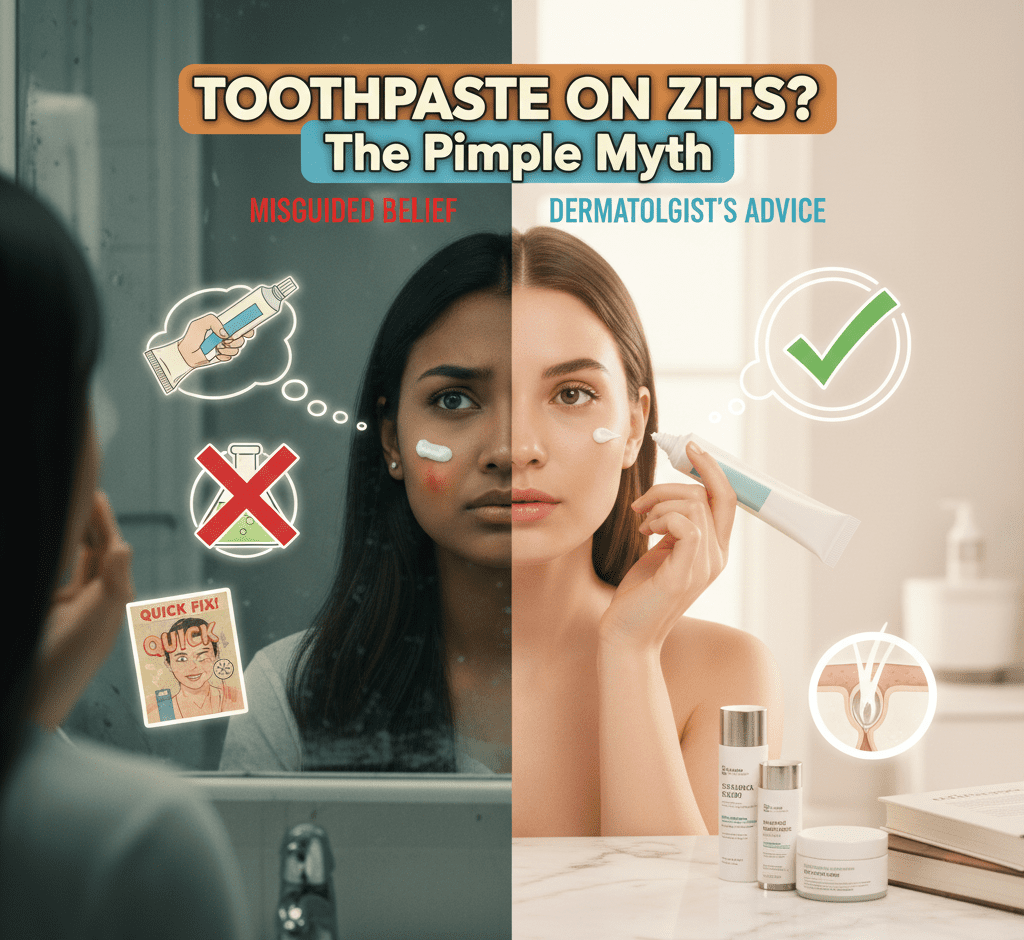
Pimples are one of the most common skin concerns that affect people of all ages. When a breakout appears, especially before an important event, the search for quick solutions begins. Among countless home remedies, toothpaste has emerged as a surprisingly popular option. Many people apply it overnight, hoping to wake up with clearer skin. Social media is filled with before-and-after posts, and friends often pass along this “hack” as tried-and-true wisdom.
But does toothpaste actually work on pimples, or is this just another beauty myth that refuses to die?
Let’s understand whether toothpaste really works — or if it can make things worse.
Why Do People Believe Toothpaste Cures Pimples?
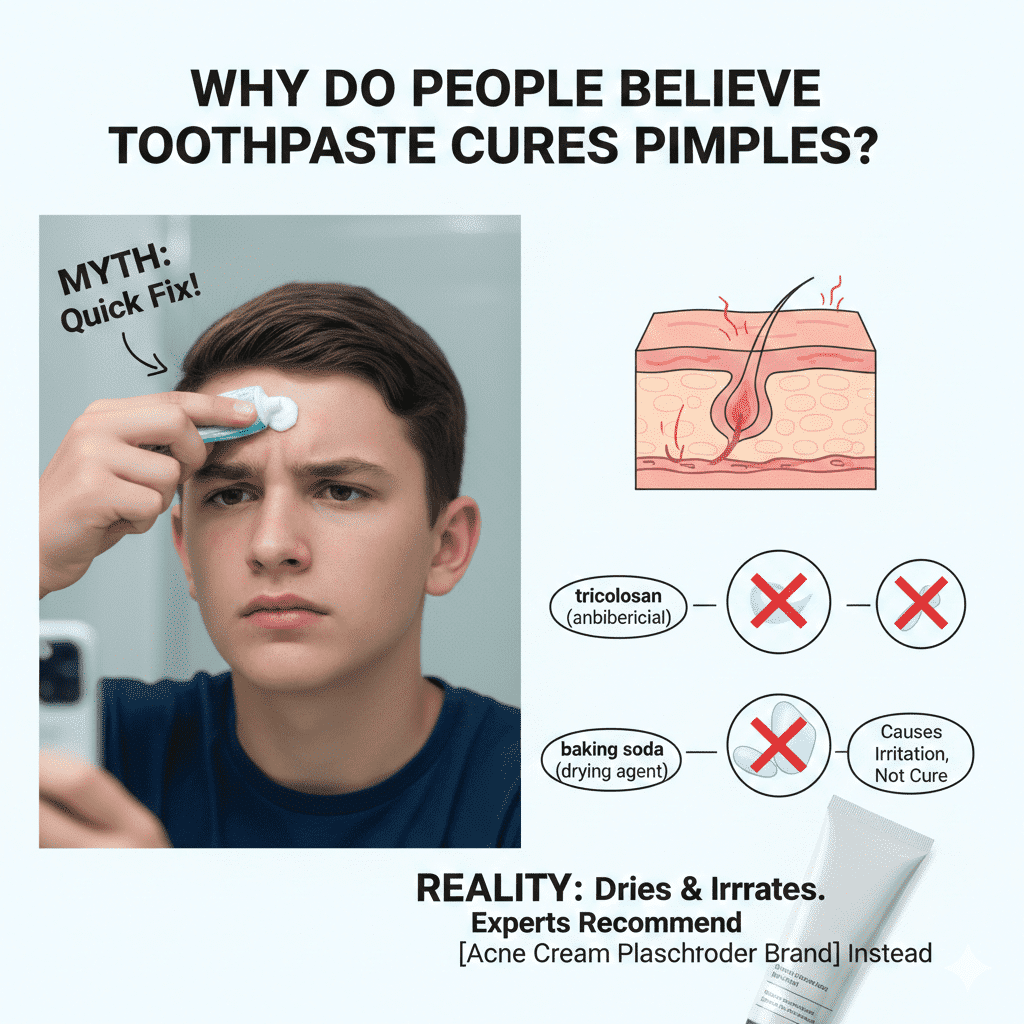
The toothpaste remedy isn’t just a random internet trend. There are several reasons why this myth has persisted for decades, and understanding them helps explain why so many people continue to try it.
The drying sensation feels effective. When you apply toothpaste to a pimple, it creates a tight, drying feeling on the skin. This physical sensation can make it seem like something powerful is happening, like the pimple is being “treated” or “attacked.” The cooling or tingling effect reinforces this belief.
Old advice passed down through generations. Long before the internet, toothpaste was recommended by parents, older siblings, and friends as a quick fix. These personal testimonials carry weight, especially when they come from trusted sources who genuinely believe it worked for them.
Social media amplifies DIY skincare hacks. Platforms like TikTok, Instagram, and YouTube are flooded with DIY beauty content. Videos showing toothpaste application often go viral, creating the impression that millions of people can’t be wrong. The visual format makes the “proof” seem more convincing.
It feels proactive and accessible. When a pimple appears, doing nothing feels frustrating. Toothpaste is already in your bathroom, costs nothing extra, and gives you the satisfaction of taking immediate action. This psychological comfort is powerful, even if the remedy itself isn’t effective.
This section isn’t about judging anyone who’s tried toothpaste on pimples. It’s about recognizing why this myth has such staying power and why it feels so believable.
Does Toothpaste Actually Cure Pimples?
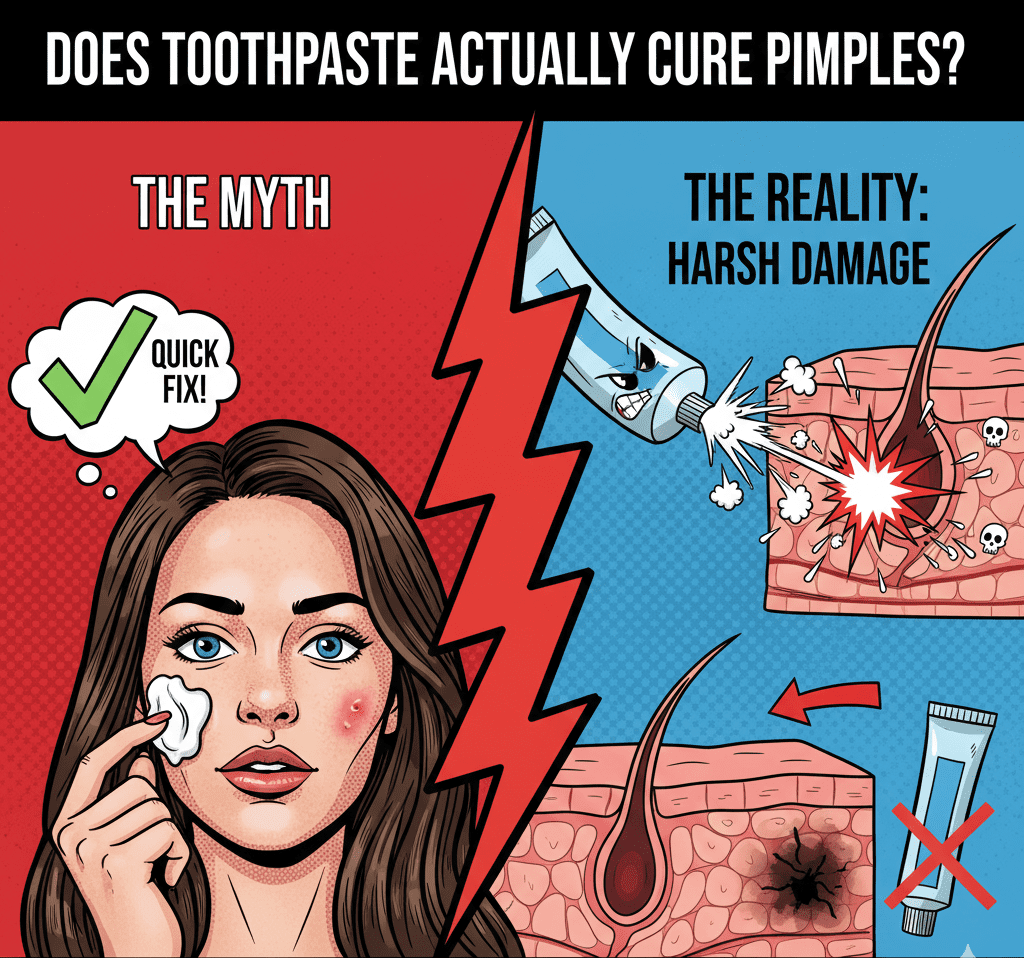
Short answer: No, toothpaste does not cure pimples.
While this might be disappointing to hear, especially if you’ve seen it “work” for someone else or even for yourself in the past, the science is clear. Toothpaste is formulated specifically for cleaning teeth and freshening breath. It was never designed, tested, or approved for use on facial skin.
Toothpaste does not treat the root cause of acne. Pimples form when pores become clogged with oil, dead skin cells, and bacteria. Effective acne treatment addresses these underlying factors. Toothpaste, on the other hand, only sits on the surface of the skin. It cannot penetrate pores, reduce bacterial growth in a meaningful way, or regulate oil production.
Any drying effect is temporary and superficial. Some people notice that a pimple looks smaller or less inflamed after using toothpaste overnight. However, this is usually just surface-level drying, which can actually be counterproductive. The skin around the pimple may become flaky, red, or irritated, while the pimple itself remains unchanged underneath.
Modern toothpaste formulas are even less suitable for skin. Older toothpaste formulations contained higher concentrations of certain drying agents, which is partly why this myth originated. Today’s toothpastes include a wide range of ingredients designed for oral health, many of which are harsh, irritating, or completely ineffective for skin concerns.
The bottom line is that toothpaste lacks the active ingredients necessary to treat acne safely and effectively. More importantly, it contains several ingredients that can actively harm your skin.
What Happens When You Apply Toothpaste on Pimples?
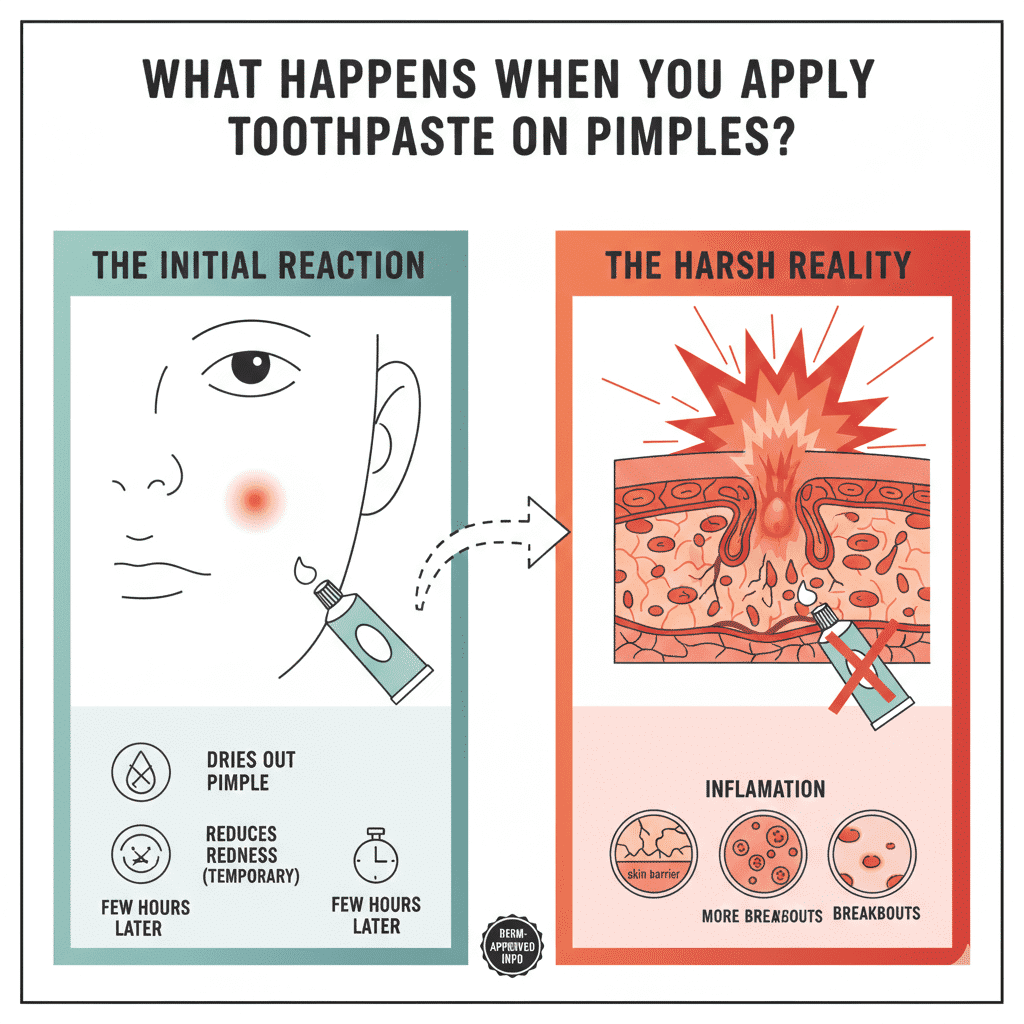
Understanding the potential side effects can help you make an informed decision about whether toothpaste belongs anywhere near your face.
Skin irritation and sensitivity. Toothpaste contains ingredients that are safe for the mouth but far too aggressive for facial skin, which is thinner and more sensitive. Many people experience stinging, burning, or discomfort within minutes of application.
Redness and inflammation. Instead of reducing the appearance of a pimple, toothpaste often makes the surrounding area red and inflamed. This defeats the purpose entirely, as you end up with a more noticeable blemish that’s harder to conceal.
Excessive dryness and flaking. The drying agents in toothpaste can strip the skin of its natural moisture barrier. This leads to tight, uncomfortable skin that peels and flakes, creating texture issues that last longer than the pimple itself.
Damage to the skin barrier. Your skin’s protective barrier is essential for keeping moisture in and irritants out. Repeated use of harsh products like toothpaste can weaken this barrier, making your skin more vulnerable to bacteria, environmental damage, and future breakouts.
Post-inflammatory hyperpigmentation. Dark spots or marks can develop after the skin has been irritated or damaged. For people with deeper skin tones, this risk is particularly concerning, as these marks can persist for months or even years.
Allergic reactions. Toothpaste contains fragrances, preservatives, and other additives that can trigger allergic reactions or contact dermatitis in sensitive individuals. Symptoms can include swelling, itching, rash, or blistering.
What seems like a harmless experiment can actually lead to more skin problems than you started with.
Ingredients in Toothpaste That Can Harm Skin
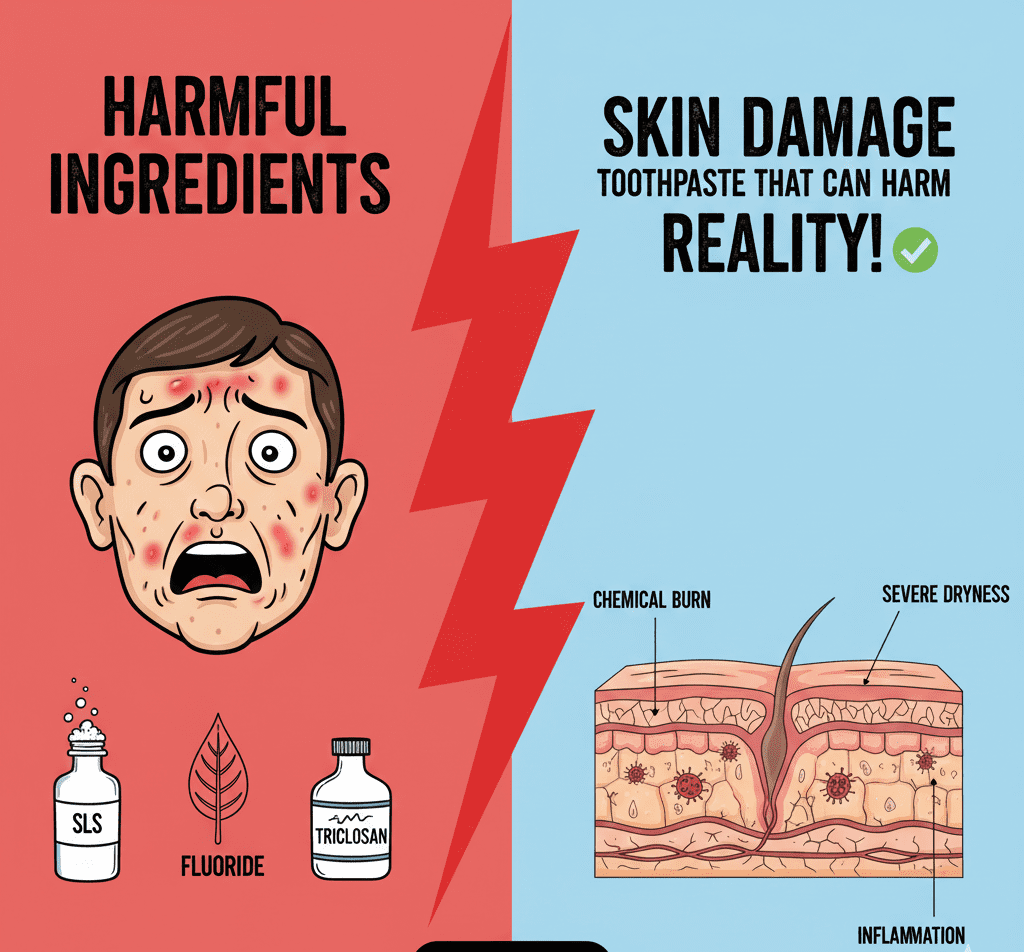
To understand why toothpaste is problematic for skin, it helps to look at what’s actually inside the tube.
Menthol and peppermint oil create that cooling, tingly sensation that makes toothpaste feel “active.” While this is refreshing in your mouth, it can cause significant irritation on facial skin. These ingredients are known skin sensitizers.
Baking soda (sodium bicarbonate) is a common toothpaste ingredient valued for its whitening and abrasive properties on teeth. However, it has a high pH level that disrupts the skin’s natural acid mantle, leading to dryness, irritation, and increased sensitivity.
Hydrogen peroxide is sometimes included for its whitening effects on teeth. On skin, it can cause bleaching, irritation, and damage to healthy tissue. It’s far too harsh for regular facial application.
Sodium lauryl sulfate (SLS) is a foaming agent that helps toothpaste create that satisfying lather. It’s also a known skin irritant that can strip away natural oils and cause dryness and inflammation.
Artificial fragrances and flavors make toothpaste pleasant to use in your mouth but serve no purpose on your skin. These additives are common allergens and can cause reactions ranging from mild redness to severe contact dermatitis.
Triclosan (in some antibacterial toothpastes) is an antimicrobial agent that’s been controversial even in oral care products. It’s not appropriate for treating acne and can contribute to irritation and bacterial resistance.
All of these ingredients are perfectly safe when used as intended — for brushing your teeth. But they’re simply not formulated with facial skin in mind, which is why toothpaste should stay in the bathroom sink, not on your face.
When Does It Seem Like Toothpaste “Works”?
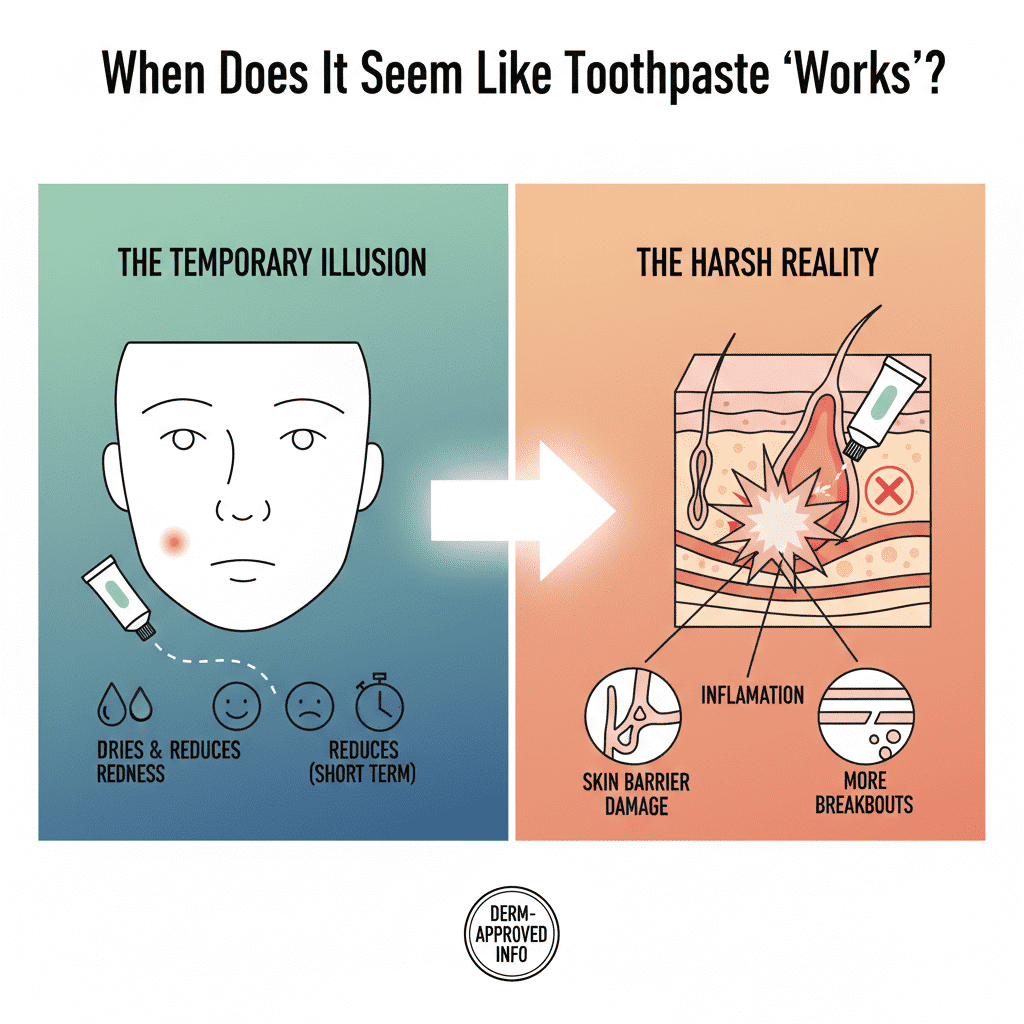
If toothpaste doesn’t actually treat pimples, why do so many people swear by it? There are a few logical explanations that have nothing to do with the toothpaste itself.
Pimples often shrink on their own. Most pimples follow a natural lifecycle. They appear, reach a peak, and then gradually heal — usually within a few days to a week. If you happen to apply toothpaste during the later stages of this cycle, the pimple may improve simply because it was already on its way out.
The placebo effect is powerful. Believing that something will work can influence how you perceive the results. If you expect toothpaste to help, you might focus on any slight improvement while overlooking irritation or lack of real change.
Toothpaste creates surface-level drying. This can make a pimple appear slightly flatter or less prominent in the short term. However, this is purely cosmetic and temporary. The underlying inflammation and blockage remain untouched.
Timing and coincidence are often mistaken for causation. People tend to remember the times toothpaste seemed to help and forget the times it didn’t. This creates a false pattern of success that reinforces the myth.
Other factors contribute to healing. You might use toothpaste while also drinking more water, getting better sleep, or simply leaving the pimple alone (which is often the best approach). These other factors actually drive the improvement, but the toothpaste gets the credit.
This doesn’t mean people are lying when they say toothpaste worked for them. It just means they’re attributing improvement to the wrong cause. Understanding this can help you make better choices for your skin.
Can Toothpaste Make Acne Worse?
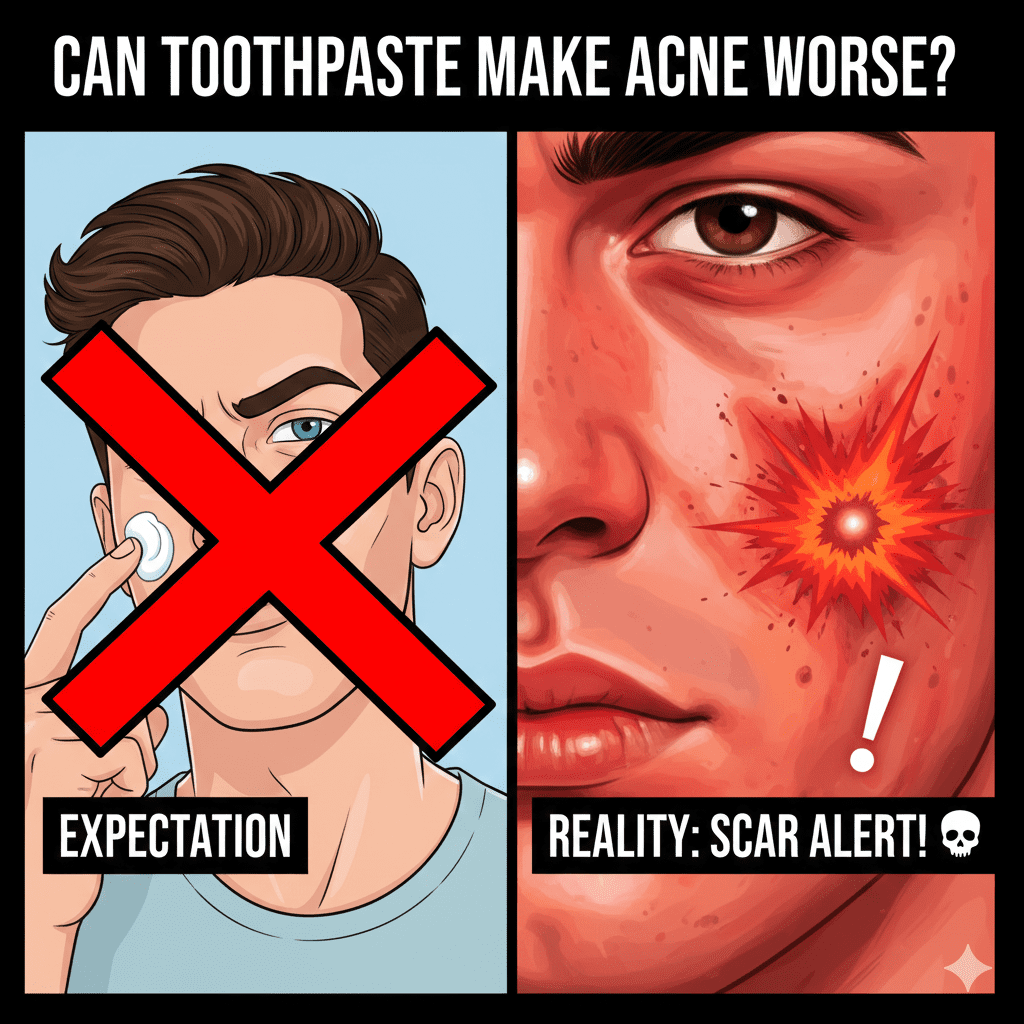
Not only is toothpaste ineffective for treating pimples, but in many cases, it can actually trigger more skin problems.
Irritation can lead to increased breakouts. When your skin is irritated or damaged, it can respond by producing more oil to protect itself. This excess oil can clog pores and lead to new pimples, creating a frustrating cycle where you’re actually causing the problem you’re trying to solve.
Over-drying triggers reactive oil production. Your skin has built-in mechanisms to maintain balance. When toothpaste strips away too much moisture, your oil glands may go into overdrive to compensate. This is especially problematic for people who already have oily or combination skin.
Weakened skin barrier increases vulnerability. A damaged skin barrier makes you more susceptible to bacterial infection, environmental irritants, and inflammation — all of which can worsen acne. What started as a single pimple can escalate into a more widespread problem.
Risk of scarring and hyperpigmentation. The irritation caused by toothpaste can damage skin tissue, increasing the likelihood of permanent marks or discoloration. These effects often last much longer than the original pimple and can be more difficult to treat.
Chemical burns are possible. In severe cases, particularly with prolonged application or sensitive skin, toothpaste can cause actual chemical burns. This results in pain, blistering, peeling, and potentially permanent skin damage.
For anyone struggling with acne, the last thing you need is a remedy that creates additional problems. The risks simply aren’t worth the minimal (and temporary) benefits some people claim to experience.
What Should You Do Instead of Using Toothpaste?
If toothpaste isn’t the answer, what actually works? Here are some safer, more effective approaches to managing pimples.
Practice gentle cleansing. Keep your skin clean without over-washing or using harsh scrubs. A mild, non-comedogenic cleanser used twice daily helps remove excess oil and impurities without stripping or irritating the skin. This creates a better foundation for healing.
Use products designed for spot treatment. Look for ingredients that are actually proven to help with acne, applied in formulations designed for facial skin. These products are tested for safety and effectiveness, unlike toothpaste.
Avoid picking, squeezing, or constantly touching pimples. This is arguably the most important advice. Manipulating a pimple increases inflammation, introduces bacteria, and raises the risk of scarring. Leave it alone as much as possible.
Give your skin time to heal. Pimples don’t disappear instantly, no matter what product you use. Most blemishes resolve on their own within 3-7 days. Patience is often the best treatment.
Consider your overall skincare routine. Sometimes breakouts are caused or worsened by products that are too heavy, pore-clogging, or irritating. Simplifying your routine and choosing non-comedogenic options can make a significant difference.
Stay hydrated and manage stress. While skincare is important, internal factors also play a role in skin health. Adequate water intake and stress management can support your skin’s natural healing processes.
Consult a professional if needed. For persistent, severe, or painful acne, seeking guidance from a dermatologist or healthcare provider is the most effective approach. They can recommend treatments tailored to your specific skin type and concerns.
The key is to work with your skin, not against it. Gentle, consistent care almost always outperforms harsh, desperate measures.
Common Myths Related to Toothpaste and Pimples
The toothpaste myth is just one of many misconceptions about acne treatment. Let’s clear up a few related myths that often circulate alongside it.
Myth: Toothpaste kills acne bacteria ❌
While toothpaste may contain some antibacterial ingredients, they’re not the right type or concentration to effectively treat acne-causing bacteria. Proper acne treatments target specific bacterial strains with proven ingredients.
Myth: Toothpaste works overnight to eliminate pimples ❌
The overnight transformation photos you see online are usually the result of lighting, angles, or natural healing that would have happened anyway. Toothpaste doesn’t have the power to dissolve or eliminate a pimple in a few hours.
Myth: Toothpaste is a safe, natural home remedy ❌
Just because something is a household product doesn’t make it safe for skin application. Toothpaste contains synthetic chemicals and is formulated for an entirely different purpose. “Natural” doesn’t automatically mean gentle or appropriate.
Myth: White toothpaste is safer than gel toothpaste ❌
Some people believe that white, paste-style toothpaste is less irritating than colored gel formulas. While gel toothpaste may contain additional dyes, both types contain problematic ingredients for skin. Neither is a good choice.
Myth: If it tingles, it’s working ❌
The tingling or burning sensation from toothpaste isn’t a sign of effective treatment — it’s a sign of irritation. Your skin is reacting negatively, not healing.
Being able to distinguish between helpful information and persistent myths empowers you to make better choices for your skin health.
Final Verdict
After examining the claims, ingredients, and real-world effects, the conclusion is clear: toothpaste does not cure pimples.
While it may create a temporary drying effect that makes a pimple appear slightly less prominent in the short term, this superficial change comes at the cost of potential irritation, inflammation, and even long-term skin damage. Toothpaste lacks the active ingredients necessary to treat acne effectively and contains numerous components that can actively harm facial skin.
Pimples require skin-appropriate care. Products specifically formulated for acne treatment are designed with facial skin in mind, tested for safety and effectiveness, and targeted toward the actual causes of breakouts. These are the solutions worth your time and investment.
Your skin deserves better than a bathroom experiment. It’s understandable to want quick results, especially when a pimple appears at an inconvenient time. However, patience and proper care consistently deliver better outcomes than shortcuts that promise miracle results.
If you’ve tried toothpaste on your skin in the past, there’s no need to feel embarrassed or concerned. Many people have experimented with this remedy based on well-meaning advice or viral trends. What matters now is moving forward with information that actually serves your skin’s health.
Your skin is resilient, and with gentle, consistent care, it has an amazing ability to heal itself. Trust the process, skip the toothpaste, and choose approaches that support your skin rather than stress it.
FAQ
Can toothpaste remove pimples overnight?
No, toothpaste cannot remove pimples overnight. While it may cause some surface drying that makes a pimple look slightly less prominent, this is temporary and doesn’t address the underlying inflammation or infection. Most pimples need several days to heal naturally, regardless of what topical product is used.
Is toothpaste safe for acne-prone skin?
No, toothpaste is not safe for acne-prone skin. It contains ingredients like menthol, baking soda, and sodium lauryl sulfate that can irritate, dry out, and damage the skin barrier. Acne-prone skin actually needs gentle, non-irritating care, which makes toothpaste particularly unsuitable.
Why do people still use toothpaste for pimples?
People continue using toothpaste on pimples because the myth has been passed down through generations, amplified by social media, and reinforced by coincidental improvements that had nothing to do with the toothpaste itself. The psychological need for immediate action and the accessibility of toothpaste also contribute to its persistent popularity despite a lack of scientific support.